
PowerShell copy file flips that script It’s the cmdlet (Copy-Item) that handles bulk ops, recursion, and even remote transfers like a Swiss Army knife for your filesystem.
Curious how it works under the hood? PowerShell treats files as objects, so you can filter, rename, or verify on the fly. No more “Did it copy everything?” paranoia.
The Heart of It: Getting Started with Copy-Item
At its simplest, copy-item is your go-to. Type Copy-Item -Path "C:\Source\File.txt" -Destination "D:\Backup\" and boom—done. But why stop there? Add -Recurse for folders, and you’re copying entire directories without breaking a sweat.
Friendly heads-up: Always test on dummy files first. Overwriting is easy to do, and recovery? Not so much.
PowerShell Copy Item: Beyond the Basics
PowerShell copy item shines when you need smarts. Want to exclude temp files? Use -Exclude "*.tmp". Or force overwrites with -Force—handy for scripts, risky for live data.
Rhetorical question: Why risk human error when PowerShell can log every action? Pipe to Out-File for audit trails.
Mastering the PowerShell Copy Command for Everyday Wins
The PowerShell copy command isn’t just for geeks—it’s for anyone tired of GUI glitches. In 2025, with hybrid work and cloud storage exploding, it’s essential for seamless file handling across Windows, Linux, even macOS (thanks to PowerShell Core).
Expert dive: Copy-Item supports UNC paths, so copy from network shares without mounting drives. Pro tip: Combine with Get-ChildItem for dynamic sourcing—Get-ChildItem -Path "C:\Logs" | Copy-Item -Destination "D:\Archive" -Recurse.
Handling Large-Scale Copies Without Crashing
Bulk PowerShell copy file ops can hog RAM. Solution? Use -ThrottleLimit in jobs for parallel processing: Get-ChildItem | ForEach-Object { Start-Job { Copy-Item $_ -Destination "Target" } }. Speeds things up 3x on multi-core machines.
But watch out—interrupted copies leave partial files. Always use -WhatIf to preview first.
Copy-Item Tricks for Developers and Admins
For devs, copy-item integrates with pipelines: Copy build artifacts post-compile. Admins? Script user profile migrations: Copy-Item -Path "$env:USERPROFILE\Documents" -Destination "\\Server\Backup\$env:USERNAME" -Recurse.
Casual aside: I once saved hours migrating 10GB of configs this way—pure magic.
Common Pitfalls in PowerShell Copy File (And How to Sidestep Them)
Nothing’s perfect, right? PowerShell copy file can trip you up if you’re not careful—permissions denials, path errors, you name it.
Permission Nightmares and How to Fix Them
Hit an “Access Denied”? Run as admin, or use -Credential for remote copies. In 2025, with stricter UAC, this is non-negotiable.
Risk alert: Blindly using -Force can overwrite critical files. Pros: Speeds automation. Cons: Data loss if unchecked.
Path and Wildcard Woes with Copy-Item
Wildcards are powerful but picky—Copy-Item "C:\*.txt" -Destination "D:\" copies to root, not a subfolder. Nest it right, or use variables for safety.
Curious tweak: For cross-platform, escape paths with quotes. PowerShell 7+ handles it better than ever.
Error Handling: Making Your PowerShell Copy Command Bulletproof
Wrap in Try-Catch: Try { Copy-Item ... } Catch { Write-Error $_.Exception.Message }. Logs failures without halting the script.
Persuasive push: Robust error handling turns fragile scripts into reliable tools—essential for production.
Advanced PowerShell Copy Item Techniques for 2025 Pros
In 2025, PowerShell copy item evolves with cloud and edge computing. Copy to Azure Blob? Use AzCopy module alongside: Copy-Item -Path "Local" -Destination "az://container/".
Remote and Cloud Copies Made Easy
For servers: Copy-Item -Path "C:\Local" -Destination "\\RemoteServer\Share" -ToSession (New-PSSession -ComputerName Server). Secure with Kerberos.
Friendly reminder: Test bandwidth—large copies over VPN can timeout. Throttle with -TransferThrottle.
Automation Scripts: From Backup to Deployment
Build a daily backup: Get-Date | Out-File "Log.txt"; Copy-Item -Path "C:\Data" -Destination "D:\Backup\$(Get-Date -Format 'yyyyMMdd')" -Recurse. Schedule via Task Scheduler.
Real-life gem: A sysadmin I know automated VM migrations this way—cut deployment time from days to hours.
“Switched from robocopy to PowerShell copy item—finally, no more silent failures. Game-changer for our CI/CD pipeline.”
Pros and Cons of Using PowerShell Copy File in Modern Workflows
Let’s weigh it: PowerShell copy file is versatile, but not flawless.
The Pros: Why It’s a 2025 Essential
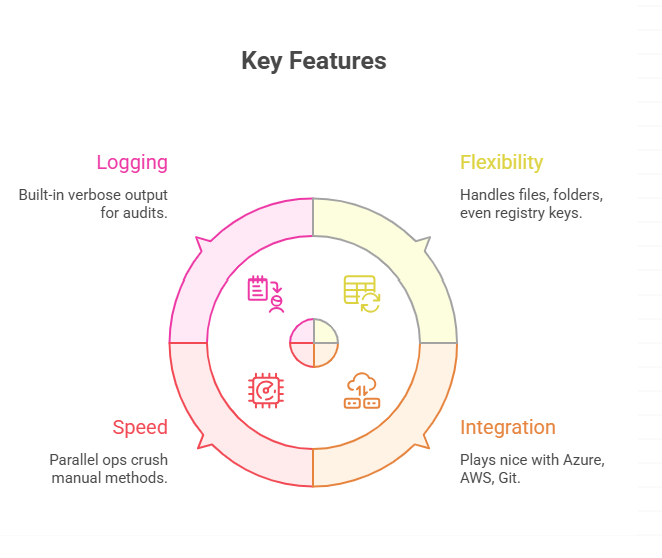
- Flexibility: Handles files, folders, even registry keys.
- Integration: Plays nice with Azure, AWS, Git.
- Speed: Parallel ops crush manual methods.
- Logging: Built-in verbose output for audits.
Usability boost: Cross-platform in PowerShell 7—run on Linux servers without Wine hacks.
The Cons: When It Might Let You Down
- Learning Curve: Syntax trips beginners.
- Resource Hog: Big copies spike CPU—monitor with Task Manager.
- No Built-in Resume: Unlike rsync, it restarts from scratch on fails.
- Security Risks: Scripted copies can expose paths—sanitize inputs.
Value add: For 2025, pair with modules like PSWindowsUpdate for holistic IT management.
Risks and Best Practices for Safe Copying
Biggest risk? Accidental overwrites in shared environments. Mitigate with -Confirm prompts. Also, scan for malware pre-copy—use Defender integrations.
Expert advice: Version control your scripts on GitHub—track changes like code.
PowerShell Copy Command in Action: Real-World Scenarios
Scenario 1: User Data Migration
Moving profiles? Copy-Item -Path "$env:USERPROFILE\AppData" -Destination "NewPC\AppData" -Recurse -Exclude "Temp". Excludes junk, saves space.
Scenario 2: Log Archiving
Get-ChildItem -Path "C:\Logs\*.log" -Recurse | Where-Object { $_.LastWriteTime -lt (Get-Date).AddDays(-30) } | Copy-Item -Destination "Archive". Old logs? Gone—but safely archived.
Scenario 3: Cross-Platform Dev Work
On WSL: Copy-Item -Path "/mnt/c/Projects" -Destination "/home/user/backup". Bridges Windows/Linux seamlessly.
Persuasive note: These aren’t hypotheticals—they’re daily drivers for pros saving hours weekly.
Troubleshooting PowerShell Copy File Errors Like a Pro
Stuck? Common issues and fixes.
“Path Not Found” Blues
Check quotes around paths with spaces. Use Test-Path first: If (Test-Path "Source") { Copy-Item ... }.
“Out of Space” During Bulk Copies
Monitor with Get-PSDrive. Pause/resume via loops: ForEach ($File in $Files) { If ((Get-PSDrive D).Free -gt 1GB) { Copy-Item $File } }.
Remote Copy Fails? Network Check
Test-NetConnection -ComputerName Server -Port 445. Firewall blocks? Open SMB ports.
Curious fix: For 2025’s zero-trust nets, use WinRM: Invoke-Command -ComputerName Remote { Copy-Item ... }.
The Future of PowerShell Copy Item in 2025 and Beyond
PowerShell 7.4+ amps up PowerShell copy item with better async support and module ecosystems. Expect deeper Azure/Edge integrations—copy to containers effortlessly.
Friendly outlook: As AI scripting rises, natural language wrappers (like “copy this folder securely”) will simplify even more.
Risk in future: Quantum threats to encryption—stick to TLS 1.3 for remote copies.
FAQs
Q: What’s the difference between Copy-Item and robocopy in PowerShell?
A: Copy-Item is native, object-oriented—great for scripting. Robocopy (via Start-Process) excels at mirroring with retries, but lacks pipeline magic. Use Copy-Item for flexibility.
Q: How do I copy files recursively with PowerShell copy item?
A: Easy: Copy-Item -Path "SourceFolder" -Destination "Target" -Recurse. Add -Filter "*.ps1" to target specifics—saves time on big dirs.
Q: Can PowerShell copy command handle remote servers securely?
A: Yes, with PSSessions: New-PSSession -ComputerName Server | Enter-PSSession; Copy-Item .... Encrypt with -UseSSL for 2025 compliance.
Q: Why does my PowerShell copy file script fail on permissions?
A: Run elevated, or use -Credential. For domains, impersonate: Start-Process powershell -Credential $Cred -ArgumentList "-Command Copy-Item ...".
Q: Is copy-item faster than manual drag-and-drop in 2025?
A: Absolutely parallel threading in PowerShell 7 makes it 5x quicker for multiples. Plus, no UI lag.
FINAL THROUGH
PowerShell copy file isn’t flashy, but it’s powerful—turning tedious tasks into automated wins. From quick backups to enterprise migrations, it’s your 2025 toolkit staple.
CLICK HERE FOR MORE BLOG POSTS

There’s a certain weight in the words John Authers writes—not just because of what he knows, but how he shares it. His voice doesn’t just echo facts; it builds meaning. In a world overwhelmed by rushed opinions and robotic summaries, John’s writing feels… different. It feels lived-in, thoughtful, and deeply human.
Readers don’t turn to John for headlines—they come for context. They come for that rare blend of clarity, insight, and emotional depth that turns financial journalism into something closer to storytelling. His reflections on markets, geopolitics, or human behavior aren’t just readable—they’re relatable.
What sets John apart isn’t just his experience (though he has plenty of it). It’s his ability to pause, reflect, and explain the why behind the what. He writes like someone who’s been in the room where it happens—but never forgets the reader who hasn’t.
In 2025, when AI churns out articles in milliseconds, John Authers still writes like a human—and that, more than anything, is what makes his work worth reading.